


Genius Solutions - Genius ERP

The context
Genius Solutions is a Quebec-based software development firm focused on the manufacturing sector. Their flagship product, Genius ERP, is an enterprise resource planning (ERP) platform built for small and mid-size manufacturers across North America. It supports complex manufacturing models like make-to-order (MTO), engineer-to-order (ETO), custom manufacturing, and job-shop setups—streamlining everything from production planning and inventory to accounting and shop-floor control.
Already a powerful platform, Genius Solutions partnered with us to integrate artificial intelligence and take their ERP to the next level. Here’s how we built predictive models and laid the foundation for a domain-specific agentic assistant within Genius ERP.
Project details
The challenge
Because Genius ERP is self-hosted, each client runs their own instance and uses the platform in their own unique way. That presents a challenge for predictive modelling, which uses historical data to forecast future outcomes. A model trained on one client’s data doesn’t necessarily apply to another’s. For example, a custom EV manufacturer and a wooden table maker operate with different timelines, materials, and workflows (and the underlying data varies just as widely). To build something scalable, we needed a generalized approach that was broad enough to be useful for all users, but smart enough to surface meaningful insights.
We faced similar complexity when approaching our work on the agentic assistant. These systems go beyond static answers and can take initiative, make decisions, and use tools. To be effective, they require a strong foundation: a well-seeded knowledge base filled with domain-specific content. In our case, that meant processing more than 5,000 hours of multilingual content across various formats (video, audio files, guides, glossaries, and more).
We were challenged to strike a balance between speed and accuracy. The fastest AI responses can risk hallucinations, while the most accurate systems suffer latency. We set out to engineer a system that was both fast and trustworthy, by carefully curating the assistant’s context window and adding source citations to ground its responses in fact.
The task at hand
Our focus split across two tracks: predictive models and the agentic assistant.
Part One: Predictive Models
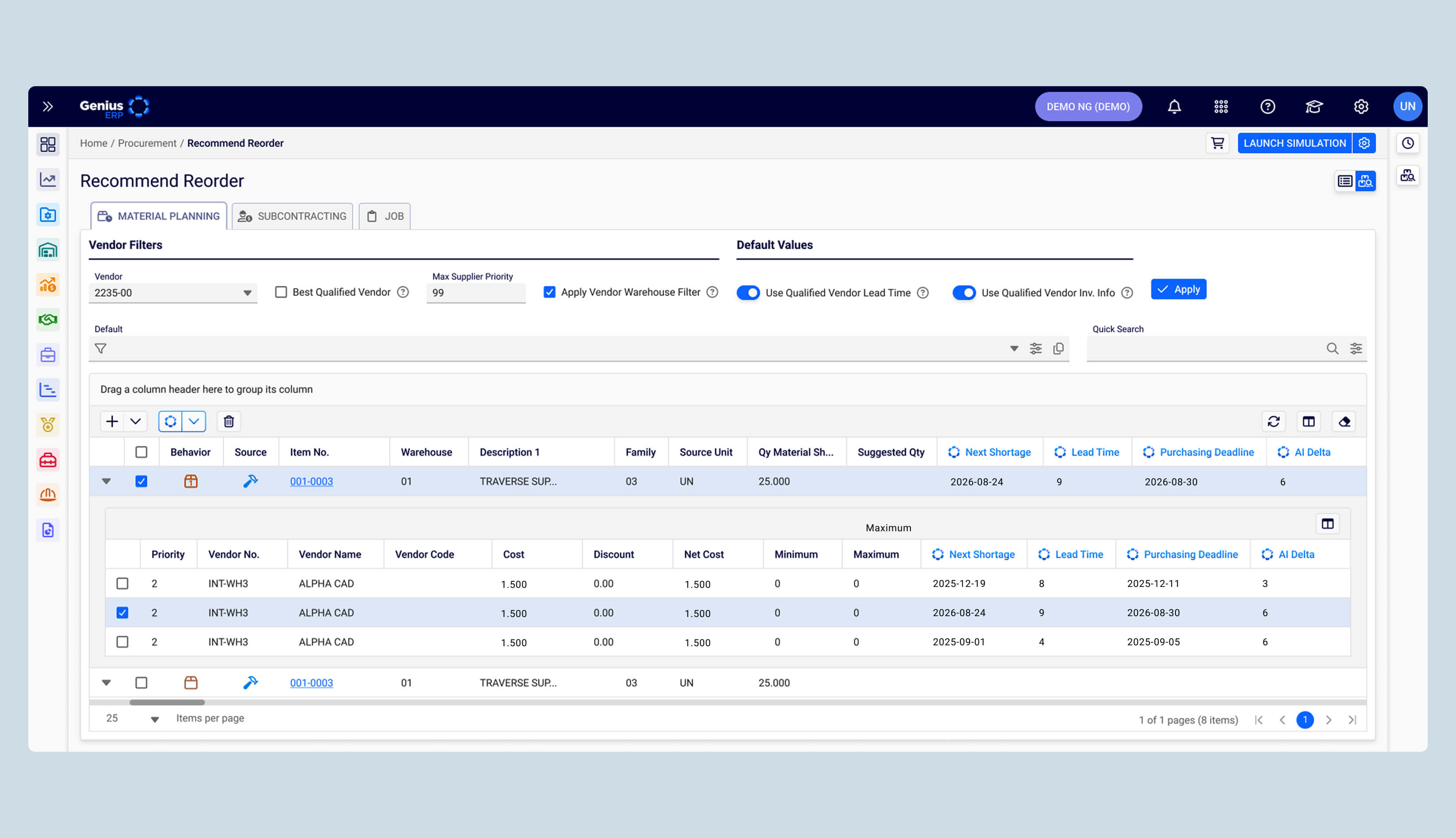
To create machine learning models that could make accurate predictions for manufacturers using the rich data (already collected in the ERP), we targeted three high-impact use cases: Vendor Lead Time, Job Delays, and Demand Forecasting.
Use Cases
- Vendor Lead Time - Predicts whether a supplier will deliver late based on historical data. For example, if a battery module supplier regularly misses deadlines, the ERP can flag it early, helping EV manufacturers adjust build schedules or find alternatives.
- Job Delays - Anticipates delays in production jobs caused by a variety of factors, including supply issues, planning gaps, machine downtime, or human-related challenges. The ERP uses historical data to flag risks early, helping teams adjust schedules and keep operations on track.
- Demand Forecasting - Estimates future inventory needs. If next month’s forecast shows a spike in demand for a specific EV model, the ERP calculates what parts (such as charging units or chassis components) need to be restocked and when.
Before this project, Genius ERP offered light automation, like reorder reminders, though most decisions were still manual. Our goal was to embed predictive intelligence into the workflow. We used traditional supervised ML models for lead time and job delay predictions. For demand forecasting, we built a hybrid solution combining Chronos (a time-series forecasting foundation model), classical ML, and statistical methods.Each client has their own database, so we created an automated pipeline using Azure Machine Learning. This securely fetches client data, trains models in the cloud, and deploys them back into the environment, keeping everything up to date without manual work.
Part Two: Agentic Assistant
In the second part of the project, we laid the groundwork for an agentic assistant, named Cortex, that could serve as an always-on, in-platform expert. Cortex uses natural language to query a deep knowledge base sourced from two rich content hubs: Genius’ Online Help Guide (which includes product definitions and terminology) and the Genius Academy, a learning platform full of video tutorials, quizzes, images, and other educational content.
We created Extract, Transform, Load (ETL) pipelines to pull that content, clean it up, and convert it into a latent format the assistant could understand. First, we “cracked open” documents in different formats like HTML, video, and PDF, extracting the full text with semantic meaning. From there, we used embedding models to convert the text into vector representations that can be stored and searched efficiently.
Some of the video content was over two hours long, so we developed workflows to break up long files, extract audio, process it using Whisper for transcription, and prepare it all for ingestion. To make this sustainable, we also introduced a Change Detection Feature. This identifies exactly what’s changed in the knowledge base content since the last pipeline run, so only new or updated material is processed (saving time and compute).
Because failures can happen when running pipelines, like API rate limits or service interruptions, we used a blue-green deployment strategy for the search index. That means we keep the current version live while building a new one in parallel. Once the new version is validated, we switch over instantly with no downtime.
At the application level, each ERP deployment has its own agent with access to a dedicated toolset. The most important of these is the knowledge base itself, which users can query in natural language. We built this using Semantic Kernel, Microsoft’s orchestration framework for integrating large language models into .NET applications.
.jpg)
.jpg)
.jpg)


The end result
Cortex launched in September 2025 and is now live inside Genius ERP. Even in its first iteration, it’s helping users find information faster and navigate the platform. With a scalable architecture, smart pipelines, and real-time updates, it’s built for long-term impact.
Meanwhile, the predictive models are in active development. With the architecture and training pipelines in place, we’ve automated how client data flows into model training in the cloud using Azure Machine Learning. This system not only reduces the manual overhead of managing models but also creates a path for clients to see real, ROI-driven improvements once these features go live.

What’s next
The predictive models are expected to deploy in early 2026. From better planning to sharper inventory control, these features will give manufacturers actionable insights based on their real-world data. We also helped Genius Solutions build their in-house AI capacity, including hiring a new data scientist to maintain and evolve the models after launch.
That said, good predictions require good data. We’re continuing to develop validation tools that help clients understand how their data quality affects results. Many of Genius ERP’s users run highly complex workflows with layered jobs and dependencies. For them, predictive tools like the lead time model can reduce manual guesswork and improve delivery confidence.
On the agentic side, Cortex is just getting started. Our roadmap for 2026 and 2027 includes major new features that will expand agentic capabilities across the ERP. The foundation is in place, and we’re ready to build on it.
Ready to make your ERP smarter?
If you're building tools for complex manufacturing and looking to add predictive insights or agentic intelligence, let’s talk. We can help you bring real-time decision-making, automation, and scale to your platform.
.jpg)
Did this project give you some ideas? We’d love to work with you! Get in touch and let’s discover what we can do together.
Discover the latest trends, our case analyses and practical advice to help you successfully transition toward automation.


-min.jpg)

-min.jpg)
.jpg)
.png)

-min.jpg)


We’re on a constant quest to broaden our horizons and spread wisdom. It’s all about pushing boundaries and elevating our game.