


ITHQ

The context
In 2020, the Québec government launched the Stratégie nationale d’achat d’aliments québécois (SNAAQ) through the Ministère de l’Agriculture, des Pêcheries et de l’Alimentation du Québec (MAPAQ). The strategy aims to increase the share of Québec-produced or processed foods in public institutions. To make that ambition measurable, schools, hospitals, and other government establishments must commit to clear procurement targets, either by adopting a minimum number of Québec-based menu items or by reaching a defined percentage of local products in their overall food purchases.
To support this province-wide shift, the Institut de tourisme et d’hôtellerie du Québec (ITHQ) was mandated to lead the initiative and develop a web-based platform to help institutions track and analyze the origin breakdown of their food purchases over time. The result was Tracéco, which launched its first phase in 2023 to a limited group of pilot users. As the platform prepared for a broader its second phase rollout, ITHQ issued a public Request for Proposals (RFP) to select a design partner to reconceptualize the user experience and interface.
Project details
The challenge
While powerful, the first iteration of Tracéco was dense and difficult to navigate. Built without dedicated design involvement, it functioned more like a raw database than a guided product experience. To support its next phase, the platform needed to become more intuitive and scalable. Osedea was mandated to lead the redesign of Tracéco, preserving its core technologies while elevating the overall user experience.
Historically, public institutions in Québec relied on tools like Excel and procurement software to manage invoices, budgets, and distributor supplier orders. Those systems handled transactions well but offered no visibility into the origin of their food spend. Once SNAAQ requirements came into effect, the gap became impossible to ignore.
Our central challenge was rethinking Tracéco’s user experience while leveraging its existing development foundation. The goal was to create a first-of-its-kind solution that enables public institutions to understand the ratio of Québec versus out-of-province food purchases and set measurable improvement targets. From there, they can work toward those goals with in-app guidance, alternative product recommendations, and progress tracking.
The platform needed to serve three core user types:
- Super users: Institutional buyers and procurement teams who require deep data analysis, exports, and compliance reporting.
- Operational users: Cafeteria managers and food service directors who engage more lightly with the platform to review progress and inform day-to-day purchasing decisions.
- SNAAQ consultants: Subject-matter experts who guide institutions through their transition, helping them interpret data, identify opportunities, and move toward their procurement targets.

The task at hand
We kicked things off with a full audit of Tracéco’s existing solution. Before redesigning anything, we needed to understand what worked, what didn’t, and where friction slowed users down. A Vision workshop followed to align on ambition, constraints, and success criteria.
Research came next. We conducted interviews with both super users and operational users, exploring their tools, context, and procurement journeys to understand how Tracéco could better support real-world decision-making. With those insights, we moved into Prioritization, identifying the most pressing user needs and aligning with the ITHQ team on a clearer product direction.
From a technical standpoint, we operated within a hybrid environment. Laravel Nova powered the original platform but came with structural and design constraints. VueJS enabled the creation of more dynamic pages with stronger visualizations and graph capabilities. Our challenge was to respect the existing foundation while elevating the experience where it mattered most.
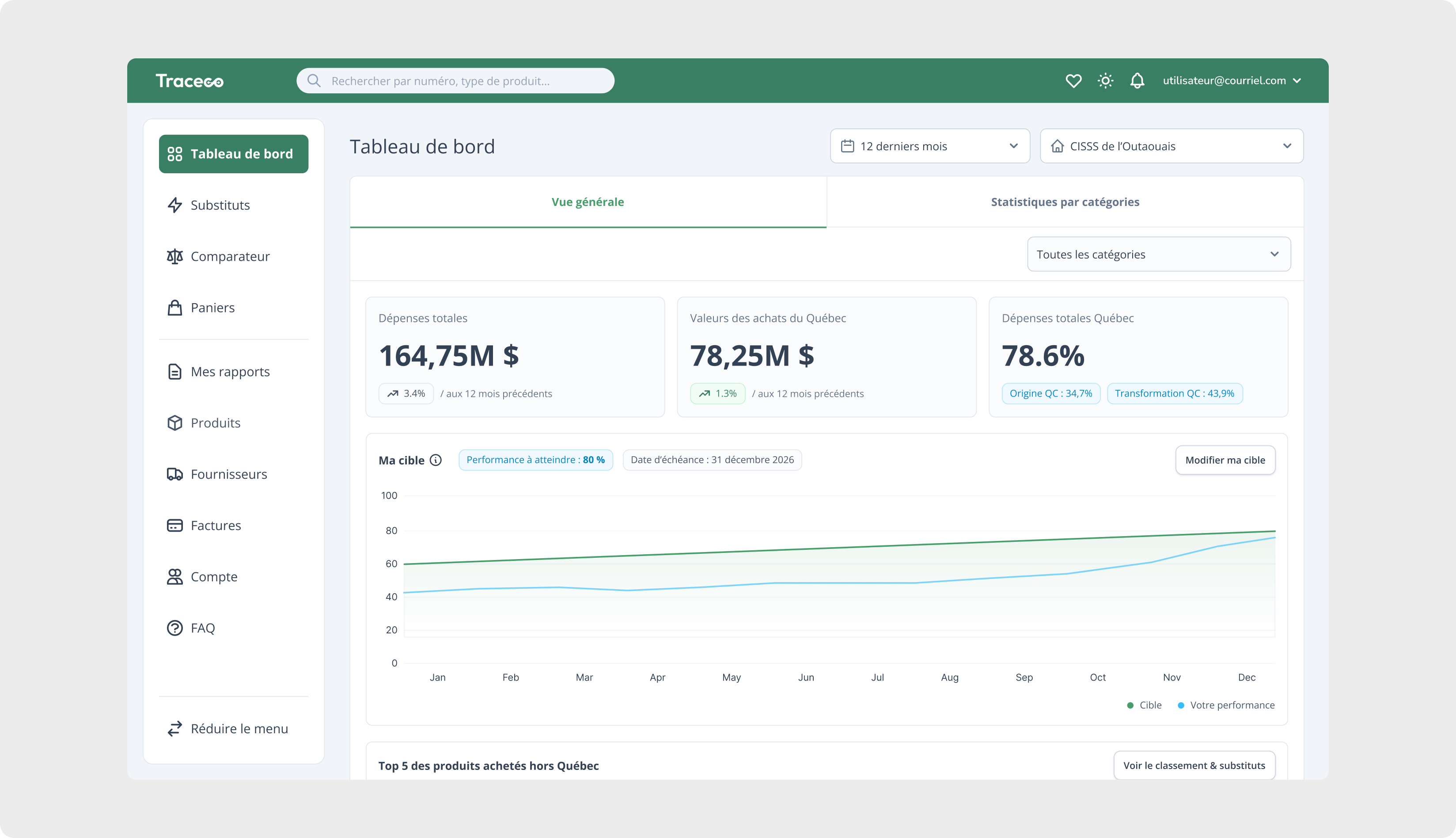
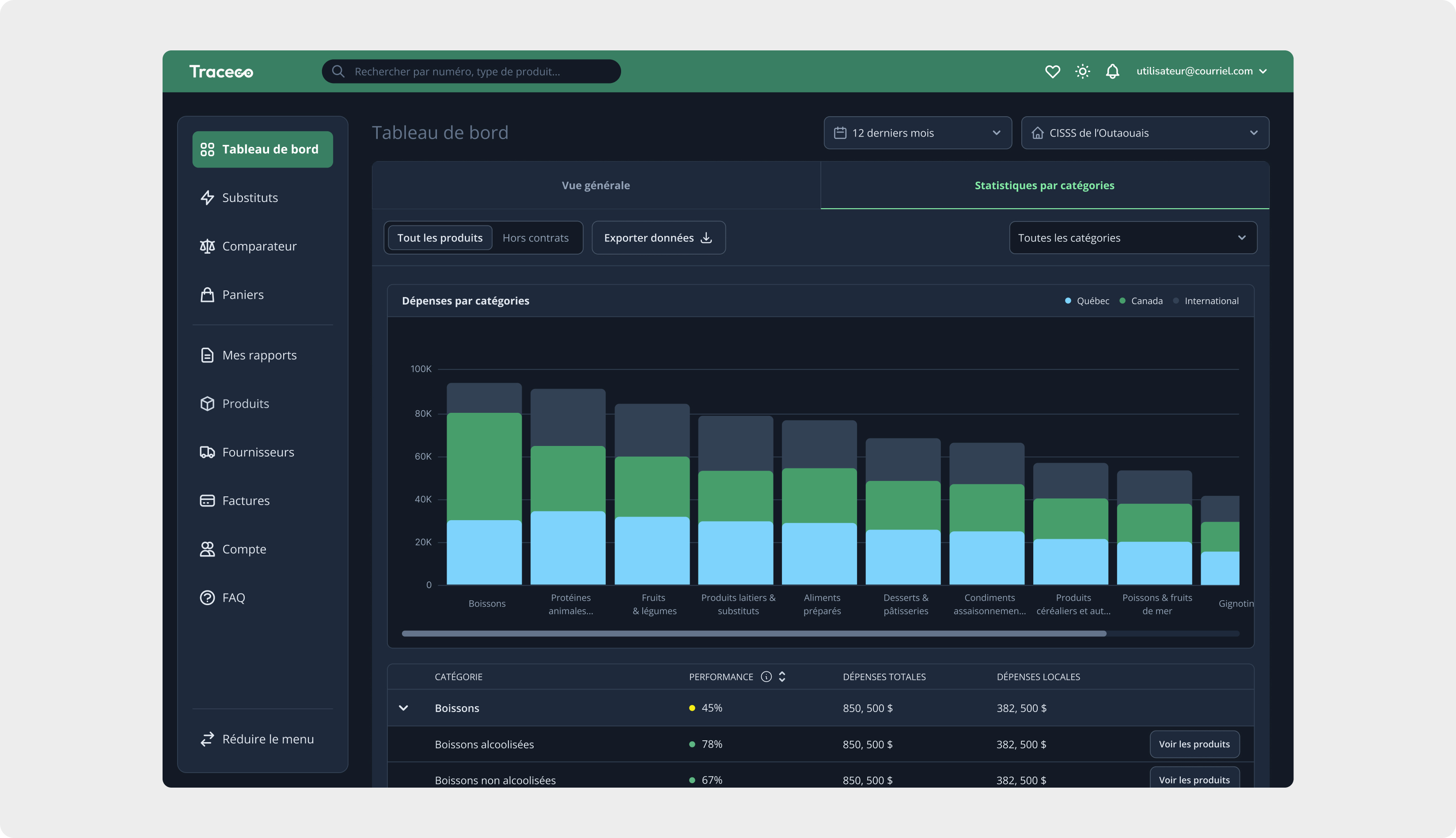
We reworked legacy screens, created a new design system aligned with Tracéco’s updated branding, and redesigned the platform flow. The dashboard saw one of the most significant transformations. Dense tables and overwhelming options were simplified into clearer categories, substitutes, and comparative views, supported by optimized filters.After building a high-fidelity prototype in hand, we returned to users for validation. Their feedback helped us refine interactions and clarify key data points. Then, with our remaining time, we introduced two high-impact features: Favourites and Baskets.

The end result
We delivered a high-fidelity prototype, annotated mock-ups in light and dark mode for every functionality, and a new design system that integrated ITHQ’s updated branding into a cohesive, modern interface.
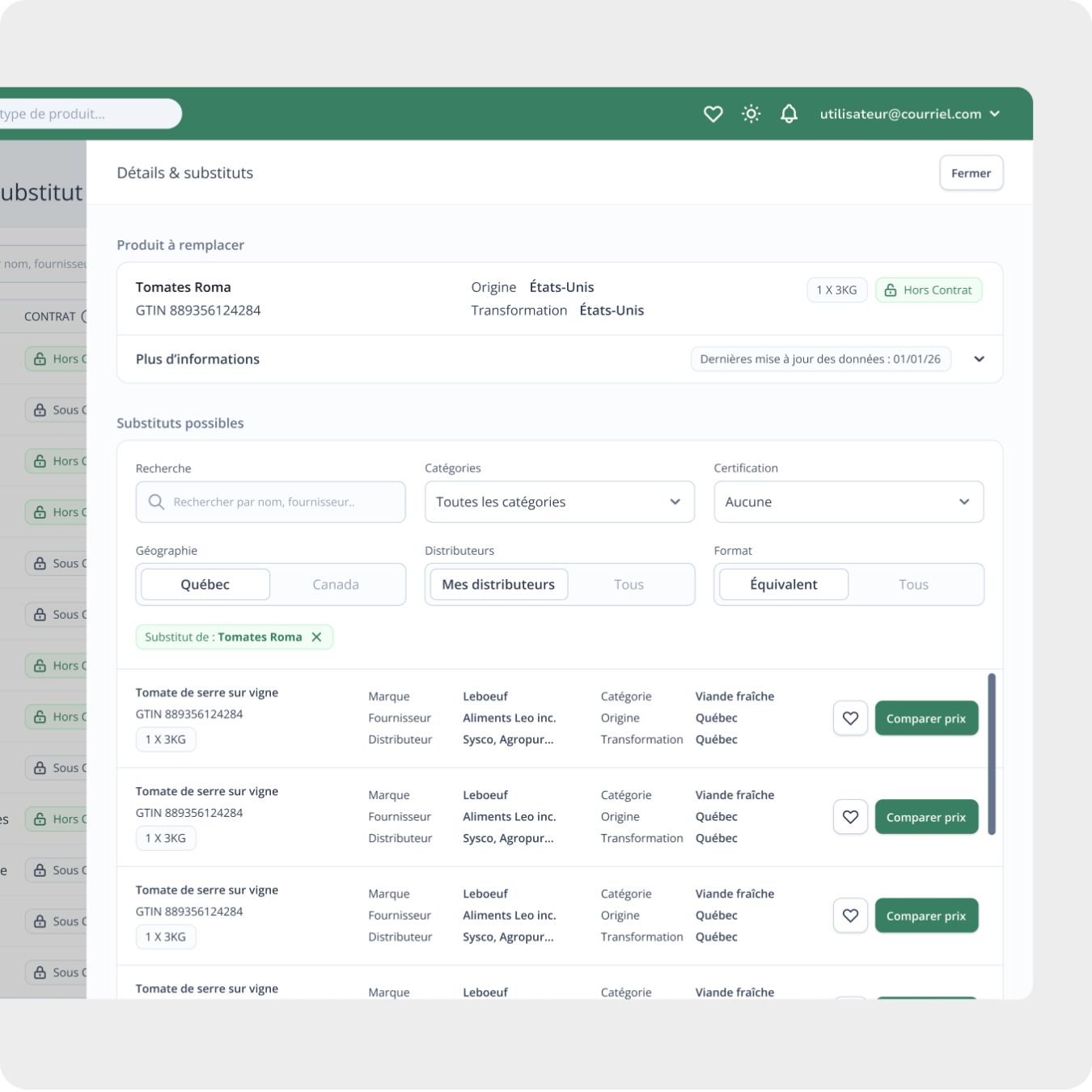
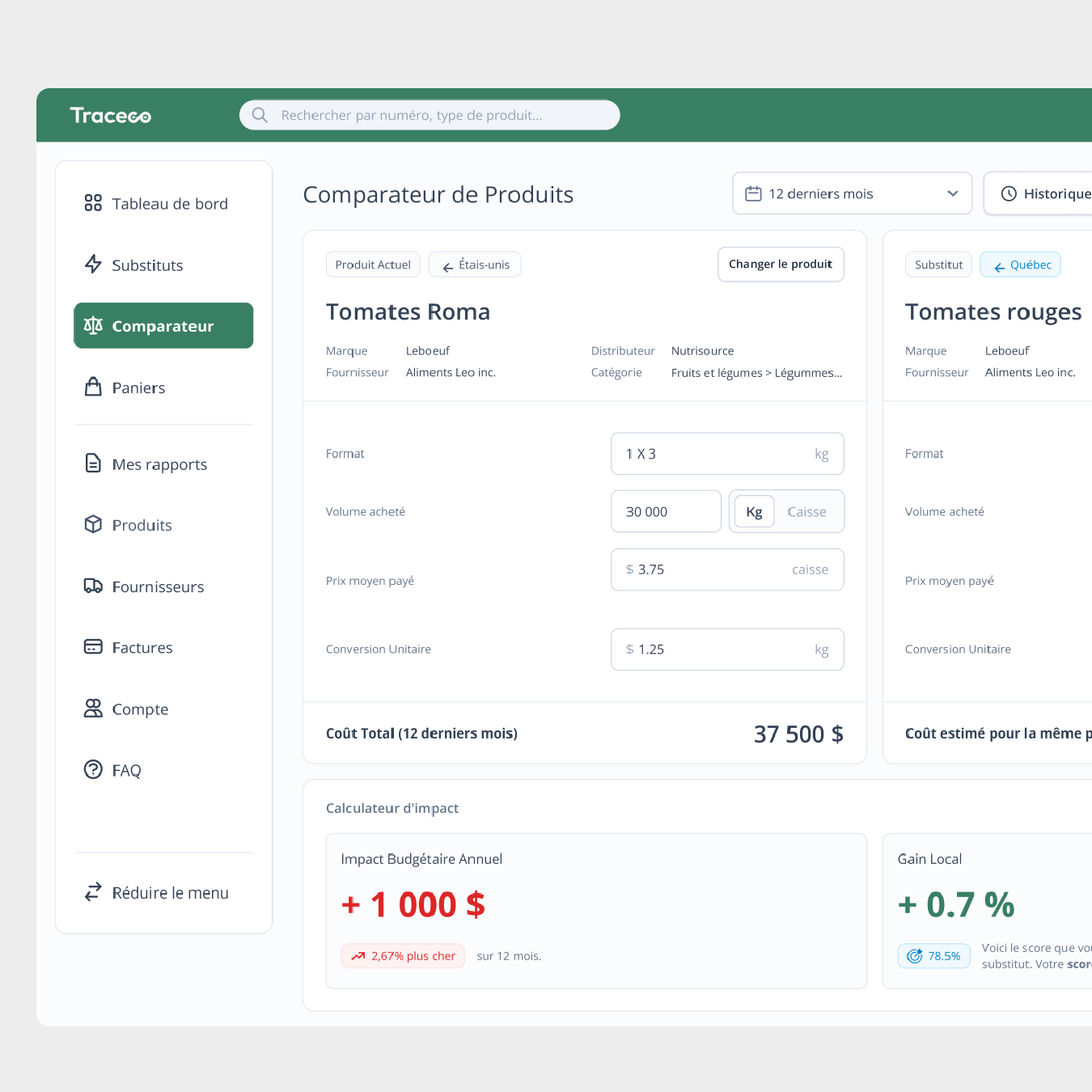
The redesigned UX and UI make the platform’s depth of information accessible, actionable, and intuitive. Users are now guided through a clear flow. They can instantly see the percentage of products with they purchase from Québec origins suppliers, identify areas for improvement, and explore alternative products in the same format or category from their existing distributor (or a new one). Built-in guidance and step-by-step prompts make it easy to test scenarios and evaluate substitutions.
To use the platform, users log in and upload purchase invoices for commonly sourced ingredients, and gain structured visibility into product origin, supplier location, and pricing data. Tracéco cross-references uploaded information against ITHQ’s database of more than 18,000 products and surfaces Québec-based alternatives, each with distributor codes and direct product links, making it easy to start pricing negotiations conversations with prospective suppliers and negotiate pricing.
For example, if an institution typically purchases ground beef from a farm supplier in Alberta, Tracéco identifies comparable Québec-based alternatives in the same format and category, complete with supplier information. Users can contact their existing distributor or a new one for more information and manually enter agreed-upon rates into the platform for future reference. They can also save products to Favourites for quick access or group ingredients into Baskets to analyze substitutions at the recipe level and compare both Québec-origin percentage and cost impact.
This transformation was made possible through close collaboration throughout Discovery and Design. While we led the UX and UI, we worked closely with ITHQ’s in-house technical lead to ensure feasibility and alignment with the existing foundation.
The redesigned platform now serves all stakeholders, not just super users, balancing analytical depth with everyday usability.

What’s next
Equipped with a validated prototype in hand, ITHQ is ready to move into development and prepare the platform for broader institutional adoption.
Tracéco has significant potential across Québec’s public institutions, serving as a decision-support tool for organizations working toward their SNAAQ commitments. By increasing institutional purchases of Québec-produced and processed foods, the platform can help drive stronger demand for local farmers, fishers, and food processors while retaining more food dollars within Québec.
We are proud to have contributed to a project with meaningful, province-wide impact. By strengthening regional supply chains, supporting jobs across the biofood sector, and reinforcing food autonomy and sustainability objectives, Tracéco represents the kind of innovation we care deeply about. Helping public institutions make more informed, locally-minded procurement decisions reflects the kind of innovation we care deeply about.
Ready to rethink your user experience and unlock the full value of your technology? Let’s talk.
Did this project give you some ideas? We’d love to work with you! Get in touch and let’s discover what we can do together.
Discover the latest trends, our case analyses and practical advice to help you successfully transition toward automation.


We’re on a constant quest to broaden our horizons and spread wisdom. It’s all about pushing boundaries and elevating our game.