Robotics
Physical AI isn't just about humanoids

Most conversations around physical AI tend to circle around humanoid robots or self-driving cars.
These examples dominate headlines and shape how the topic is perceived.
Meanwhile, a different kind of progress is taking place in industrial environments.
Across factories and warehouses, physical AI is being introduced in a much more grounded way. The changes are incremental, sometimes barely noticeable at first, but they are starting to reach a wider range of manufacturers, including smaller ones.
Manufacturers must embrace intelligent robotics now
Industrial operations are dealing with a combination of constraints that are becoming harder to manage.
Labour is difficult to secure. Costs continue to rise. Supply chains remain fragile. At the same time, production requirements are shifting toward shorter cycles and more variability.
Traditional automation addressed part of this. It delivered consistency and efficiency where conditions were stable.
As soon as variability enters the process, things become more complex. Small changes in positioning, lighting, or material can require significant adjustments to the system.
Why more manufacturers can now adopt these systems
Several technologies have reached a level where they can be used together in real environments:
- Sensors and cameras capture more detailed information.
- AI models are better at interpreting what they see.
- Simulation tools allow systems to be trained and tested before being deployed.
This changes how automation is approached. Instead of defining every step in advance, systems can now be trained and refined over time. Variations in lighting, positioning, or materials become part of what the system learns to handle.
This is driven by methods like reinforcement and imitation learning, combined with multimodal models and more dexterous hardware, allowing robots to adapt in real time.
A mix of approaches rather than a single solution
Industrial robotics is evolving through a combination of methods:
- Rule-based systems remain essential. They are still the most efficient option for stable and repetitive tasks. (e.g., welding in industrial settings)
- Training-based systems introduce flexibility. They rely on data and simulation to deal with controlled variation. (e.g., adaptive kitting)
- Context-based systems are starting to appear. They can interpret instructions and operate in less predictable situations.
These approaches are used together, depending on the level of variability and the requirements of the task.
For many manufacturers, adoption begins with a single use case rather than a full transformation.
Where it's already applied
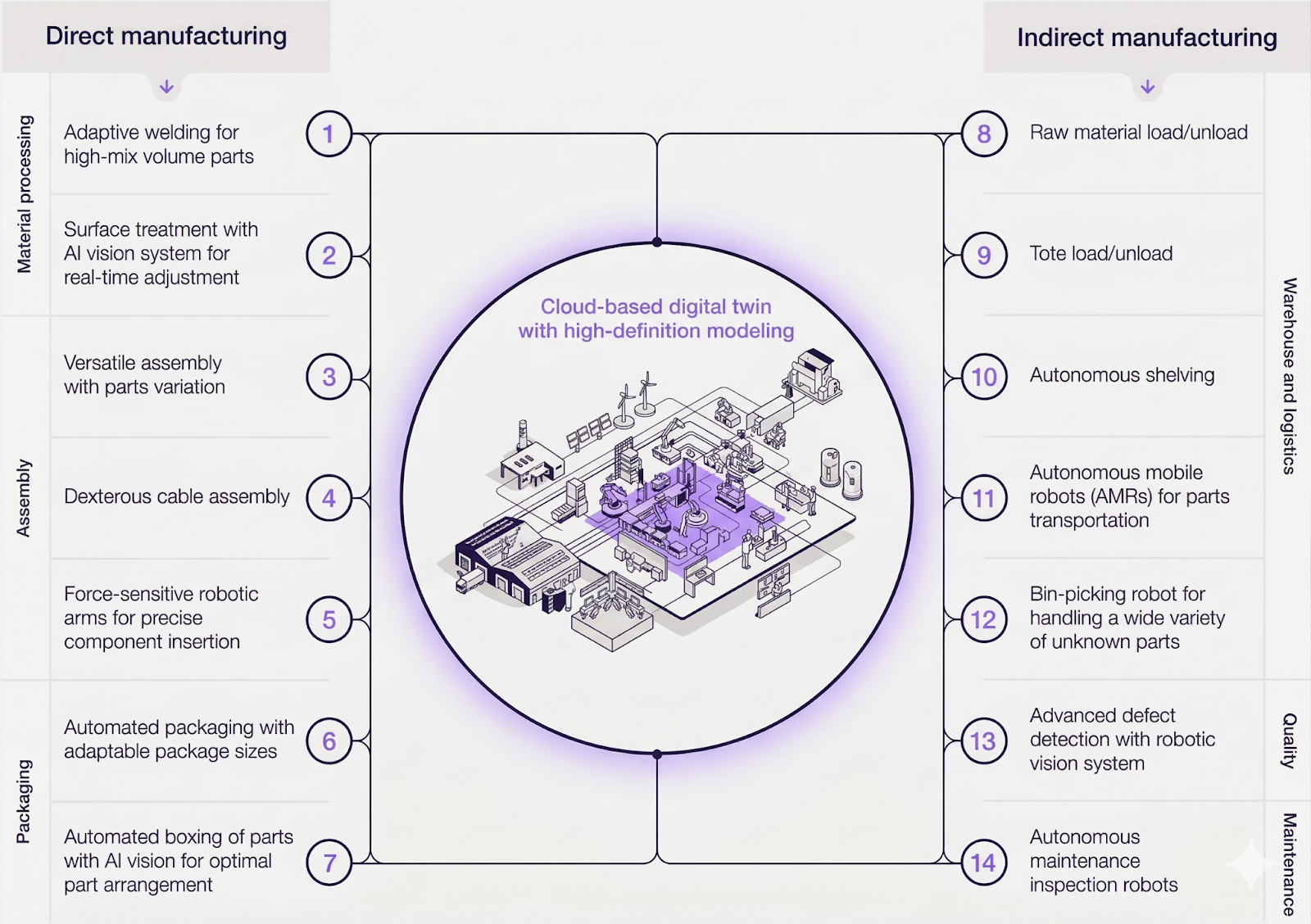
Case study E-commerce fulfilment, Amazon
Amazon operates more than a million robots across hundreds of fulfillment centers. The scale is often highlighted, but what matters more is how the system is built.
Over time, different layers of automation were introduced:
- mobile robots bringing inventory to workers
- vision systems improving sortation
- packing lines optimized for material usage
- robotic arms handling an increasing share of items
Each of these improved a specific part of the process. The limitation was that they were mostly operating in isolation.
The shift came when these systems started to be connected.
Instead of optimizing individual steps, the focus moved to the full flow, from inbound receiving to outbound shipping, with AI coordinating decisions across the system.
Some of the newer systems illustrate this:
- Sequoia manages storage and retrieval at scale
- Sparrow uses vision and AI-driven motion planning to pick a large portion of items and improves continuously with data
- Proteus moves autonomously in shared spaces, navigating around people and adapting in real time
Amazon has shown how orchestrating mobile robots, AI-driven sortation, and generative AI-guided manipulators can transform fulfilment centres, achieving 25% faster delivery, a 25% increase in efficiency, and a 30% rise in skilled roles
What sits behind this kind of system
Amazon shows what is possible, and the work required to get there.
Several layers need to fit together. Hardware, perception, decision-making, and control all depend on each other. A small issue in one part can affect the rest.
Different types of expertise are also needed:
- robotics and hardware
- AI and vision
- software systems
- knowledge of how operations actually run
None of these is enough on its own.
This is why these systems are usually built with multiple teams or partners.
What looks smooth in the end comes from connecting systems step by step and adjusting how they work together over time. That is where most of the effort is.
Manufacturers who act now and make robotics a core part of their operations will lead the next phase of industrial competition, shaping how growth, work, and resilience evolve.
At Osedea, we donʼt believe in one-size-fits-all robotics. We specialize in engineering custom solutions that bridge the gap between complex software intelligence and the physical realities of your business. Whether you're looking to solve a specific defect detection challenge or want to explore the potential of Physical AI in your facility, weʼre ready to collaborate. Letʼs talk about whatʼs possible.

Did this article start to give you some ideas? We’d love to work with you! Get in touch and let’s discover what we can do together.
Further Reading


-min.jpg)


-min.jpg)
.jpg)