AI
What AI has to get right in 2026

Working in computer vision and AI, it’s hard not to see that for a long time AI has been about ”MORE”.
More capability. More scale. More promises.
For a while, that momentum felt like the product. But something is shifting.
Not because the technology slowed down, but because reality started pushing back.
Infrastructure has limits. Organizations have limits. People have limits. And systems that look impressive in a demo behave very differently when they have to run every day, inside messy processes, under real constraints, with real consequences.
In production, consistency matters more than peak performance.
AI is no longer being judged by what it can do in isolation. It’s being judged by what it can sustain in the real world.
And 2026 is where those forces become hard to ignore.
How autonomy becomes operational in 2026
We’re moving from automation to autonomy, and it isn’t just a vocabulary upgrade.
Instead of isolated tools that wait for instructions, we're building multi-agent systems that coordinate around results. A central agent sets direction, specialized agents handle parts of the work, and the whole system reacts to events as they happen.
The shift is from executing tasks to maintaining system health.
Less “run this step” and more “keep this system healthy.”
In a digital context, this autonomy acts as a "cooperative operating layer" that handles the friction between disconnected systems. Instead of a person manually syncing an inbox with a database, autonomous agents manage entire workflows: negotiating schedules, resolving logistics bottlenecks, and coordinating high-priority tasks in real-time.
They don't just process data.
They actively manage operational uncertainty. They navigate the manual gaps of communication to keep a business process stable without human prompting. This is the model being scaled by leaders like DHL, where agents autonomously manage millions of complex operational interactions.
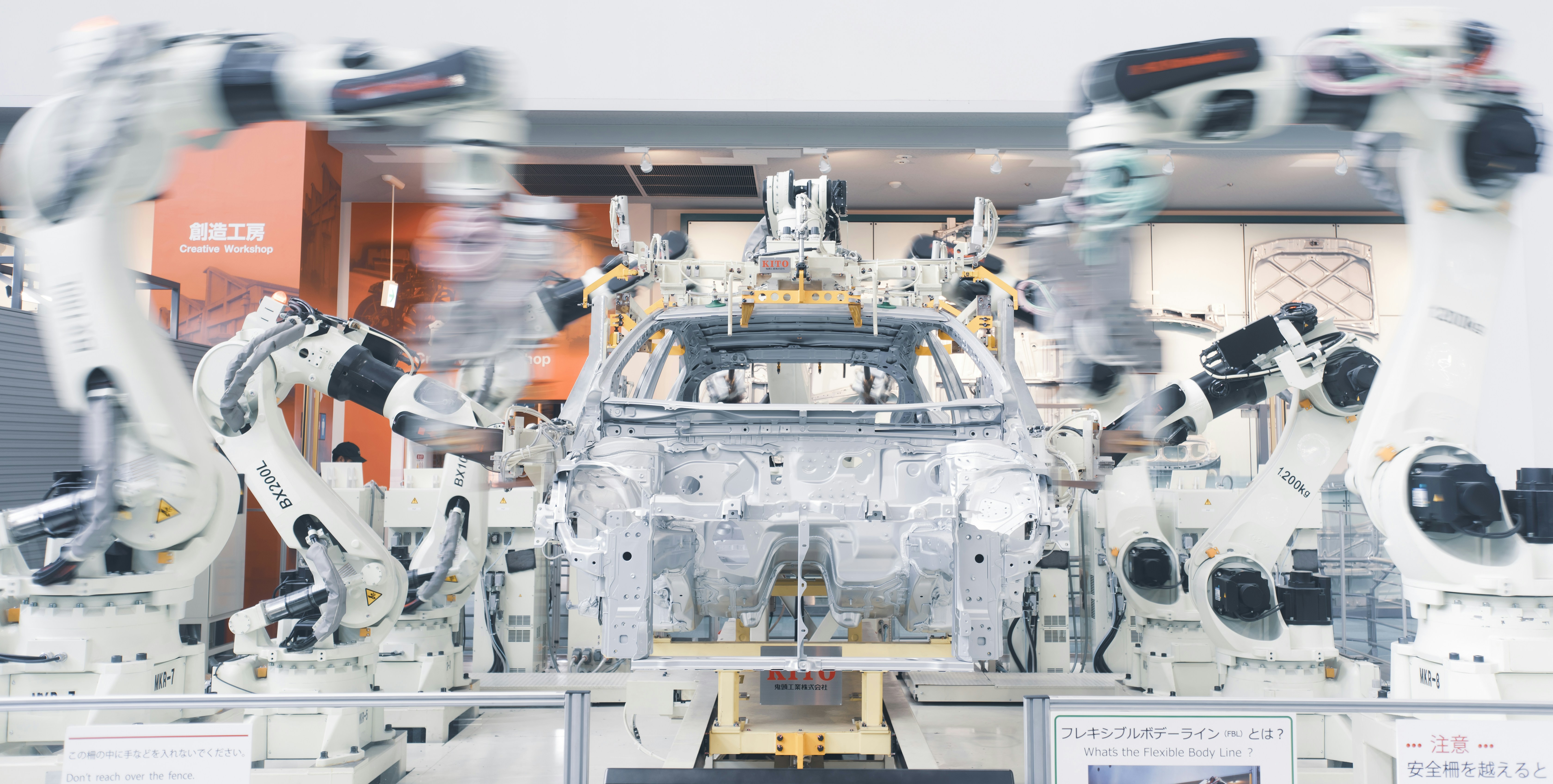
In a manufacturing plant, this might look like multiple agents working together: one monitoring machine health, another tracking throughput, a third observing quality signals, and a final agent managing maintenance scheduling.
These agents would operate under a coordinator to balance output, downtime, and defect risk, eliminating the need for manual integration.
This looks like the same kind of orchestration as in a digital workflow. But the moment you leave software and enter the physical world, the assumptions break.
Because autonomy only works if the system has a reliable grasp of the world it is acting in.
Giving an agent a goal is easy. Giving it a sense of what is physically possible, what is risky, what is changing, and what will happen if it intervenes is much harder.
That’s why the focus is moving beyond language and logic toward physical intelligence built on multimodal world models. Perception feeds spatial understanding. Spatial understanding supports reasoning about motion, interaction, cause and effect.
You can see the direction in research agendas and product roadmaps, as well as in how big tech is placing its bets.
As Fei Fei Li, a leading researcher in computer vision and AI, puts it:
“Building spatially intelligent AI requires something even more ambitious than LLMs: world models, a new type of generative models whose capabilities of understanding, reasoning, generation and interaction with semantically, physically, geometrically and dynamically complex worlds, virtual or real, are far beyond the reach of today’s LLMs.”
This is not a rejection of language models. It is a shift toward intelligence grounded in perception and physics.
Learn from 3D data and sensory experience, and the system starts to grasp how the world behaves, not just how it’s described.
That’s how you get robots that slow down when a human steps into their path, take a wider turn when carrying a heavy load, or reroute when a pallet is misplaced.
Not because someone hard coded politeness, but because the system anticipates consequences.
Where digital twins and XR become practical
In real-world deployments, the ability to interpret and act on sensor data is what separates demos from systems.
This is also where digital twins and extended reality stop being shiny and start being useful.
A digital twin is a live operational reflection of a system, continuously fed by sensor data and constraints.
Agents can test actions before touching reality.
Virtual and augmented reality turn those models into shared spatial environments where humans and systems see the same state, test the same scenarios, and argue about the same limits.
Autonomy as an organizational capability
As autonomy spreads, the more interesting question becomes organizational.
When capabilities can be turned on, combined, and scaled like software, sometimes through Robotics as a Service and sometimes through purely digital agents, organizations become more flexible in a very specific way.
Teams stop managing fixed systems and start orchestrating evolving ones.
That changes how risk is handled, how investment is planned, and how responsibility is assigned.
At that point, companies don’t just need tools.
They need partners who can design, integrate, govern, and evolve these systems over time.
Autonomy becomes an organizational capability, not a feature checkbox.
At Osedea, we help companies build autonomy that lasts by focusing on integration, governance, and operational resilience.
Why specialization is necessary for real-world AI
We’re moving past the illusion that one universal intelligence can solve every reality.
General models are powerful, but the real world has friction.
True expertise is never abstract. It’s situated.
To be useful, a system has to live inside a domain, inherit its language, absorb its constraints, and respect its rules.
That’s the logic behind domain specific models.
They’re not just smaller versions of big models. They’re shaped by the pressures of a specific field.
Domain specific language models are the obvious example. A medical model learns that abbreviations can carry life changing meaning. A legal model learns that structure and precedent matter as much as words. A financial model learns that compliance is part of reasoning, not an annoying wrapper around it.
They are designed to be correct before they are impressive.
That difference is what makes them usable in contexts where mistakes are expensive.
Also, big models often exceed the capacity of the devices where work actually happens. Cameras, machines, drones, and medical devices cannot always rely on a cloud server. They need models that run locally, on limited power, with limited memory, often with data that should not leave the device.
So instead of one giant vision model, you train a smaller one for this camera, in this factory, under this lighting. Instead of one general sensor model, you train one that knows how this machine normally behaves. Instead of sending sensitive data away, you let local models learn baselines and flag change.
This is not just a philosophical shift. Gartner lists domain specific AI and edge AI as core enterprise trends for 2026.
That same logic carries over when you move from machines to people
You stop asking what is normal in general and start asking what is normal for this one person. Their sleep. Their heart rate. Their routine. Their drift over time. That is personal intelligence in practice. A tutor that adapts to how one student actually learns. A wearable that understands one body instead of averages. A system that fits around a person instead of forcing the person to fit the system.
This does not come from bigger models. It often comes from smaller models built around a specific context, trained on less data but the right data.
It mirrors human learning. General education gives you a broad base, but at some point you stop trying to learn everything and start going deep into something specific. Foundation models play that first role. They are necessary and powerful. But expertise emerges when you fine tune them for a particular domain, rather than just making the general model bigger.
So, specialization is not just an optimization. It is a form of discipline. When knowledge is bounded, behavior becomes more predictable. When behavior is predictable, it becomes governable. And only then does trust start to stick.
This is why “one model fits all” rarely works in real operations. Domain specific models reduce risk and improve reliability.
How sustainable AI enables long-term scalability
Sustainability in AI is not about ethics alone. It is about operational survival.
When I think about sustainability in AI, I think about whether the way we build and deploy it can actually last. Whether it can exist over time without collapsing under its own cost, complexity, and dependencies.
This is tied to physical and environmental limits. Energy becomes scarce or regulated. Water becomes limited. Hardware becomes expensive and geopolitically fragile. What looks like an external issue eventually shows up as an operational one.
Right now the dominant pattern in AI is linear scaling. More data, more parameters, more compute, more energy, more infrastructure. That pattern works, but it only works as long as someone is willing and able to keep paying the growing bill, financially, energetically, and operationally.
That’s not guaranteed.
In his World Economic Forum piece, Antonio Neri, President and CEO of Hewlett Packard Enterprise, described scaling AI sustainably as a set of urgent priorities, precisely because the current trajectory is starting to collide with physical and economic limits.
Some of that scale is unavoidable. Training frontier models and running large platforms genuinely requires data centers, specialized hardware, and massive infrastructure.
But it becomes unsustainable when that same pattern is applied blindly to every use case, every product, every deployment.
Most real world problems do not need frontier models. They need systems that can run reliably for years.
It’s about choosing the right level of abstraction, the right model size, the right deployment pattern, and the right lifecycle for the problem you are actually solving. Not the biggest possible solution. Not the smallest possible solution. The one that fits.
On top of that, we must invest more heavily in the underlying infrastructure itself, much like the initiatives where DeepMind uses reinforcement learning to cut cooling energy in data centers. AMD is trying to make chips more energy efficient. Large providers like Nvidia are moving more of their infrastructure onto renewable power. And companies like Redwood Materials are reusing old batteries as energy storage. It’s a start, but we are still far from where we need to be.
Sustainable AI isn’t optional. It’s a requirement for systems that must run for years, not months.
Why ethics and security are the new trust factors
Decisions are not always made by humans anymore. More and more, AI agents run systems and make decisions on their own without anyone even noticing. And that changes everything. Where power actually sits. Who is accountable? And who ends up paying for it when something breaks.
Security becomes part of ethics here. A system that can be manipulated, poisoned, or hijacked is not just a technical risk. It is a social one. If models can be steered through prompt injection, data poisoning, or adversarial inputs, then control quietly shifts to whoever can exploit them. That is not only an engineering failure. It is a governance failure.
Another aspect is that large models require levels of computation, data, and infrastructure that only a small number of actors can realistically sustain. As a result, the ability to build and shape them becomes increasingly concentrated. That creates gaps between large and small organizations, and between wealthy and less wealthy countries. When only a few actors can train or control the most powerful systems, they end up shaping access and outcomes for everyone else.
You can feel this tension in creative fields. Many artists, writers, and designers do not experience AI as a neutral tool. They experience it as something trained on their work without consent, reproducing style without attribution, and competing on their own ground. That sense of extraction is part of the ethical problem, whether the industry is comfortable admitting it or not.
Ethical AI is about whether people keep meaningful control over how their work, data, and identity are used. It is about building systems that cannot be quietly abused, that can be questioned, and that remain governable. When these power imbalances are corrected, trust has space to form.
Trust is earned through accountability, transparency, and governance.
Closing
We’re no longer experimenting with AI. We’re building with it.
Building means systems must survive real usage, not just clean demos.
They must fit existing workflows, handle edge cases, and remain reliable as conditions change.
In 2026, the winners won’t be the teams with the biggest models. They will be the teams with the most resilient systems.
If you’re ready to move from pilots to systems you can trust, reach out.
At Osedea, we help teams design and deploy agentic workflows and specialized models that hold up in production with governance, security, and sustainability built in.


Did this article start to give you some ideas? We’d love to work with you! Get in touch and let’s discover what we can do together.
Further Reading





-min.jpg)